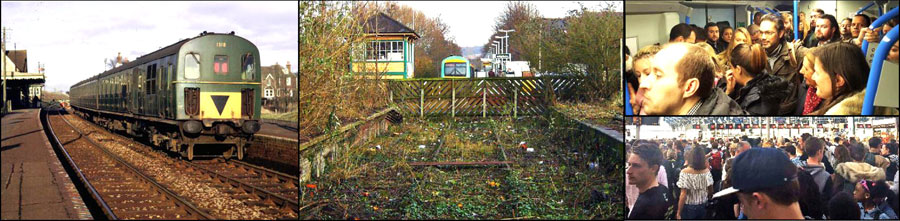
1: Brighton’s second main line all set to be electrified in 1962 – but snuffed out in 1969. Photo courtesy John Wenham.
2: Now denied its purpose of serving Surrey, Kent and Sussex – for the sake of just 7 miles of track.
3: Yes to Gatwick – but no green light for the continually-struggling Brighton Line.
We’ve been proved right in saying Gatwick was assured of a green light – the Government wouldn’t dare turn it down. But saying it’s ‘a no-brainer’ is deeply worrying because we need intelligent people at the top who really should be thinking through the serious implications of this decision. Despite being Secretary of State for Transport, Heidi Alexander is certainly no transport expert, but merely an orator for those in the Department who pull all the strings. And much like the proverbial London bus, there’ll be another one along soon.
It’s said LGW Runway 2 will enable an additional 100,000 flights per year. That equates to another 274 flights per day. In fifteen years’ time the airport’s annual total is predicted to be 389,000 flights – which mean a daily average of more than a thousand (roughly 1,068). Worryingly for Sussex and in particular the Brighton Line, passenger numbers to the airport are forecast to rise from today’s 45 million a year – to 75 million. A ‘Government source’ has defended the decision, saying “With capacity constraints holding back business, trade and tourism, this is a no-brainer for growth.” So why don’t they display the same concern around the notorious capacity constraints which have, for decades now, hampered the well-being of Sussex and especially the Brighton Line here in the overcrowded and congested South East?
Now, as Britain is currently celebrating ‘Railway 200’, former Transport Minister Michael Portillo is quite rightly criticising past ‘bad decisions’. He says ‘Less than 40 per cent of our network is electrified, which is poor compared with most developed countries’ and goes on to question our obsession with ‘extremely expensive’ high-speed lines. Most will agree that the British Isles are small compared to other countries, while at the same time our towns and cities are all relatively closely-knit. In reality, our overwhelming problems have always centred on lack of capacity and poor connectivity. Michael questions why we – as the very founders of the modern railway – have fallen so far behind and says ‘We need new railway lines but the cost has gone through the roof’ – a sentiment we all cheer.
Unfortunately, the rot and the collective torpor stretch back decades – as he will know. Back in 1989, Mark Wolfson (a West Kent MP) passed us a letter from Michael Portillo which read ‘Dear Mark, Thank you for your letter to Paul Channon enclosing one from the Director of the Wealden Line Campaign, Mr Brian Hart. First, I think it is wrong to suggest that British Rail is allowing the Uckfield Line to deteriorate.’ This was at the time when Margaret Thatcher’s Government was forcing swingeing cuts on BR. Rather than investing in what was once the South’s alternative Brighton Line, it was instead embarking upon reducing parts of this former main line to single track, while simultaneously brushing aside the well-founded fears voiced by the Wealden Line Campaign over its future safe operation. Many will know what resulted so disastrously in 1994 at Cowden....
As Transport Minister, he also referred to the campaign’s success in getting BR to put forward the serious proposal from Chris Green, Director of Network SouthEast, to reinstate the 7-mile ‘Missing Link’ in Sussex. Michael wrote: ‘I understand that they have examined the possibility of re-opening the line from Uckfield to Lewes. They have estimated that it would cost £6m to reinstate the line.’ The deal required both East Sussex and Kent County Councils, who would principally benefit from the reopening, jointly contributing £4.5m as BR was allowed to contribute only 25% (£1.5m) under its Investment Guidance Principles. But ESCC emphatically refused, its chiefs telling the Department of Transport they had £200m-worth of road projects which needed funding.
Michael Portillo’s ministerial letter to Mark Wolfson MP ends by saying: ‘However, that is not to say the issue is totally closed and I am sure that BR will keep the possibility under review in the light of passenger demand. In the meantime, BR are already committed to improving services on the Uckfield line and it should not be too long before your constituents and others who use the line begin to see the benefits.’
The Uckfield Line – having been so spitefully cut off from the Sussex Coast under Labour in 1969 and just as maliciously from Kent (Tunbridge Wells) under the Conservatives in 1985 – its once-bright prospects were extinguished. The promised yet unfulfilled schedule of electrification, growth and prosperity, timetabled for completion in 1964, is inescapably a profound tragedy suffered by the South East and continues resonating to this very day. Thirty-six years on from when Michael signed-off that letter drafted by the DoT, we are no further, despite the ardent and unrelenting efforts of the Wealden Line Campaign – now in its fortieth year....
Having replaced disgraced Transport Secretary Louise Haigh with Heidi Alexander, the next one will be ensconced in the upcoming reshuffle but, as Michael will know, it really doesn’t matter who is speaking at the podium, the party conference or interviewed on the news. That’s because the decisions are made by those shadowy civil servants who are never called to account, yet have so much power over our lives – and can’t be voted out. Michael should know more than anyone else why we’re in such a profound mess and can surely answer his own questions as to why this country has lost its way when it comes to rail.
In 2000, the French, under Connex’s MD Olivier Brousse, as well as the visiting China Railway Engineering Group in 2016, were astounded why we British still can’t reinstate seven miles of track south of Uckfield to create a much-needed new main line between London and the Sussex Coast. Nor can we electrify it so that these 32 miles of railway stretching from Sir Keir Starmer’s former home at Hurst Green in Surrey to the County Town of Lewes is commensurate with the surrounding 750vDC third-rail operational network.
These meddlesome busybodies in whatever Whitehall department or quango will continue making sure that never happens – and all the while the roughly parallel Brighton Line will go from chaos to ever-deepening crises as traffic continues overloading the railway in Sussex. Someone needs to get a GRIP – which coincidentally also stands for Governance for Railway Investment Projects. However, we’re informed that’s now been superseded by ‘PACE’ – Project Acceleration in a Controlled Environment – which, you’ll love this, ‘aims for greater flexibility, efficiency and collaborative decision-making to replace GRIP’s perceived bureaucracy’.
So there’s your answer Michael. And if those eminent and supremely-effective Southern Railway Board managers (1923-1947) are looking down upon us, then they would surely be aghast at the bureaucratic incompetents who persist in stifling railway expansion.