

Book Review --- Uckfield's Railway ~ Triumph and Tragedy
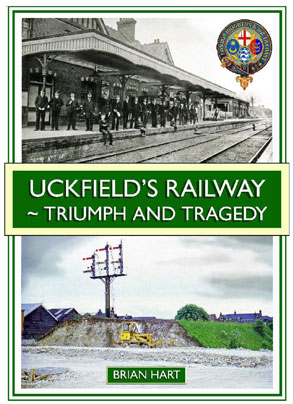 Brian Hart is probably best known for his books about Kent’s minor branch lines, featuring such gems as the Canterbury & Whitstable, Hawkhurst, Hythe & Sandgate, Hundred of Hoo and the Elham Valley Railway. These are all books that combine meticulous research and many rare photos to produce an enthralling experience for the rail enthusiast, but which also stand up as a serious contribution to both railway and local history. In all of these cases, except the Hoo branch where freight to Thamesport continues, commercial passenger traffic has long since disappeared, with no local demand for restoration and, moreover, little controversy at their time of closure. In other words, for want of a better expression, these are “fossil lines” so far as modern public transport is concerned.
However, Uckfield’s Railway is a significant new departure for Mr Hart, because while the line’s story up to WWII follows a familiar pattern to his other books, with local enterprise and initiative driving the line’s development into an important local and regional transport corridor, the story after nationalisation in 1948 takes on a disturbingly darker and dishonest political aspect. Authenticated by ample documentary evidence, he proves that local and national politicians, assisted by curiously defeatist British Rail managers, collaborated to first throttle then virtually destroy Uckfield’s railway altogether. It was only through a prolonged fight that local campaigners managed to hold onto the pitiable truncated remnant that survives today.
His impressive tome chronicles that fight – exposing the Janus-like officials, elected and otherwise, who blithely mouthed slogans about “improved local transport” while simultaneously trying to snuff out the railway in favour of road and property development – schemes that scarcely any normal person wanted. Sadly, despite spirited local opposition, this shadowy cabal succeeded twice: first by getting the rail link from Uckfield to Lewes eliminated, then again in 1985 when they managed to kill off the Eridge to Tunbridge Wells link, leaving Uckfield with only its current sparse, unreliable service to London Bridge.
As he unravels this woeful and convoluted saga, the author squarely nails the enduring myth that the Uckfield–Lewes link was an uneconomic branch line that was merely put out of its misery by Dr Beeching, as well as the equally fraudulent untruth that the decisive factor for its closure in 1969 was a weak bridge in Lewes. Suffice it to say that beholden rail managers can always find “good reasons” to do something whenever determined political pressure is brought to bear! Brian has diligently unearthed all the details of these underhand dealings and, for the very first time, exposes officials’ cynical machinations.
Moving on from the resultant closures, he also charts the history of various attempts to restore Uckfield’s railway as an important through route between East Sussex, Kent, Surrey and London. These were no misty-eyed fantasies of large steam locomotives running a “commuter service” with recycled Pullman cars etc, but hard-headed commercial propositions by seasoned railway managers. The most recent of these schemes was one with strong overseas financial backing that would have seen trains run from Brighton via Uckfield to Canary Wharf and Stratford International. And they would have succeeded, were it not for more of the political manoeuvering of the kind that crippled the line in the first place.
So, in summary, this is a book that will appeal to the rail enthusiast, transport campaigners and anyone who has ever wondered why the continually struggling Brighton line around Haywards Heath has around 14 trains an hour each way, while there remain zero trains an hour between Uckfield and Lewes. It is also a most attractive casebound book, handsomely produced in England and printed on gloss paper, which ensures that the photos – which include very many previously unpublished monochrome and colour shots – are shown to best advantage.
– ‘Alaric’
Bluebell member Brian Hart’s long-awaited magnum opus doesn’t all make for rose-tinted nostalgia. The story of the triumph behind the first railway line to reach Uckfield, initially from Lewes via Hamsey, is well recorded here and the extensions through to Tunbridge Wells and up to Oxted. There is also a chapter devoted to the fated Ouse Valley Railway.
But, as anyone who used and uses the Uckfield Line knows, the tragedy of how such a once-useful through route from Brighton ended in the pitiful incarnation that is today’s offering started a very long time ago. We will delve into why the line wasn’t electrified – despite promises made; how we very nearly lost the ‘whole lot’ south of Hurst Green; the subsequent neighbouring line closures of 1967 and ‘lopping of the line’ to Tunbridge Wells in 1985; the singling of much of the route and the general decline of services and infrastructure. Brian has uncovered some great factoids about the route and the men who worked it that make for fascinating reading.
As to the route south to Lewes, closed in 1969, the real villains were East Sussex County Council with its Phoenix Causeway severing the line for all time. Brian is not afraid to name names here! A browbeaten BR resorting to false claims about the state of its infrastructure finally completed the job of devastation. It’s too easy to say ‘Beeching is to blame’ a mere convenient myth to let ESCC off the hook. A great mix of industrial, social and political history on a local level and highly recommended.
– Bluebell News
What makes this book fascinating is the wealth of information provided by the original correspondence between parties that gives some idea of the pressure for, and equally opposition, the companies faced in early days to get their lines authorised. Original documents are plentiful and supported by a wealth of excellently-reproduced photographs. Recorded in meticulous detail, it sets an extraordinary standard that could not be bettered. ∗∗∗∗∗
– Back Track / Britain’s Leading Historical Railway Journal
A graphic image on the front cover sets the scene perfectly for a book that blows the lid off one of the worst railway planning crimes of the second half of the last century. The disgraced pro-motorway Transport Minister Ernest Marples was typically at the back of the ludicrous decision to sever the London–Brighton diversionary route south of Uckfield. Today, the vigorous campaign continues to reinstate the seven miles of missing railway, but a positive decision always seems to be beyond elected governments of all political persuasions. The author justifiably questions why the route was not electrified as promised back in 1964, but equipped instead with diesel units that were left to rot, and then it was reduced to single track. The reopening is surely just a question of willpower.
– Howard Johnston, Steam World
A fascinating detailed history. And no words minced when it comes to the sad story of the cutting back of the route and the loss of connections southwards.
– Nicholas Owen, former TV broadcaster and rail enthusiast
To describe this book as a tour de force is a cliché, but it’s difficult to find something better. This is an outstanding piece of work by a very respected author who, in his customary style, has ranged across matters topographical, political and managerial in immense detail. Uckfield’s Railway has 10 chapters, each of which could almost be a book in itself and which captures the ‘feel’ of an era whether it be early Victorian pioneering, the pre-grouping (LB&SCR) era, the days of the Southern Railway or the later 1960s when the fate of the railway matched the increasing disillusion of the nation. Later chapters detail the ongoing efforts to restore the rail link between Uckfield and Lewes as well as providing evidence of the complicity of East Sussex County Council in the downgrading and destruction of what should have been developed as a relief route for the Brighton main line. The profound effects felt from Oxted, through the Tunbridge Wells area and across the Weald are spelt out in detail. It is also worth pointing out that, for students of K&ESR heritage era history, the past machinations of Whitehall and ESCC in respect of road building and anti-rail bias have a very familiar ring. Brian has told this reviewer that he hopes people will buy the book for the text and not just to look at the pictures. It is certainly a work which requires some study and critical appraisal; it is no ‘coffee table’ volume.
– The Tenterden Terrier
A public campaign to reopen the disused line south of Uckfield to Lewes in East Sussex started almost 40 years ago. It was led then (and now) by tireless campaigner Brian Hart. He has now written a comprehensive, minutely detailed and lavishly-illustrated 288-page history of the route. When the double-track southernmost section to Lewes was closed in May 1969, what remained (and still does) was a diesel branch line to Uckfield, isolated in an otherwise all-electric commuter network. Brian writes: “It is highly doubtful whether any other railway anywhere in the UK has been so disreputably removed.” Brian’s book is quite the monumental work of a lifetime – enormous detail, enormous research – and a fabulous collation of photographs.
– Paul Clifton, BBC Transport Correspondent and contributor to RAIL magazine
Chronicler of the highs and lows of the Uckfield–Lewes railway, Brian Hart would have made a terrific barrister. He researches with diligence, unveils actions that are less than transparent and directs his barbs with pin-point accuracy. In scrutinising files at London’s National Archives, Brian discovered East Sussex County Council was pressing the Ministry of Transport to have the entire Uckfield line ‘eliminated’. In one confidential memo ESCC’s County Surveyor wrote: ‘The removal of this railway would enable a number of road improvements to be carried out at greatly reduced costs and facilitate an improved road alignment. This would be most significant as regards Uckfield Level Crossing and the bridges at Eridge, Crowborough and Groombridge, apart from several minor road crossings.’
Containing scores of illustrations (many unpublished until now) and 288 pages of riveting history, both industrial and political, the ending is hard to swallow. A fascinating book – the presentation is superb.
– Susan King, Senior Reporter, Sussex Express
Folkestone-born author Brian Hart is well-known for his numerous and much-acclaimed historical books on Kent’s railways. After moving to Sussex in 1973 and settling in Uckfield the local railways fascinated him and now his latest title Uckfield’s Railway – Triumph and Tragedy, is easily his most ambitious. Brian excels in what he loves most, featuring many accounts which pay tribute to those who toiled to create the railway. Thanks to his painstaking researches the reader is rewarded with numerous joyous and comical events, as well as the accidents and occasional tragic incidents. He provides us with a most valuable social history of this part of Sussex and Kent through the ages. He describes how the Southern Railway made formidable strides with electrification and announced plans to electrify all lines in Kent/Surrey/Sussex within a 50-mile radius of London. WWII then intervened, but afterwards Kent benefited enormously with most of its lines electrified by 1961 – and Sussex was all set to follow on. However, Transport Minister Ernest Marples supported East Sussex County Council’s ‘Lewes Inner Relief Road’ – a hugely-controversial dual carriageway slicing through the County Town and the Uckfield Line. Simultaneously, Marples halted electrifying the Uckfield Line (Lewes/Tunbridge Wells/Oxted/Croydon). BR initially fought back, showing rail traffic was growing in a fast-developing area – but, most of all, the indispensable role the Uckfield Line played in relieving worsening pressure on the adjacent Brighton Line.
Brian says: “Even today people think Dr Beeching was responsible. That’s a very convenient myth, but what shocked me most was finding evidence showing how a demoralised British Rail eventually acceded to the County Council’s maniacal road-building ambitions and deliberately sabotaged the Uckfield Line in Lewes with a false ‘emergency’ to close the railway. Now this shocking story is in the public domain. The book also exposes the real villains who continue conspiring against re-instating the railway.”
– The Kent and Sussex Courier
For those people living in the Wealden area of East Sussex and Kent, the book can be purchased from these outlets:
BLUEBELL RAILWAY – Sheffield Park Shop, (Open Tuesdays-Sundays)
Horsted Keynes Carriage Shop (Open Saturdays & Sundays)
LEWES – Boon Books, 18 High Street.
UCKFIELD – Uckfield Heritage Shop, 6 Bell Walk.
TUNBRIDGE WELLS – Waterstone’s Bookshop, 32-40 Calverley Road.
It can also be ordered direct from the Publisher, Wild Swan Books Ltd, ISBN 978 1 912038 97 8 at £39.95 plus postage. Their website also shows a selection of sample pages from the book, so please also visit that website even if you intend to purchase it elsewhere.