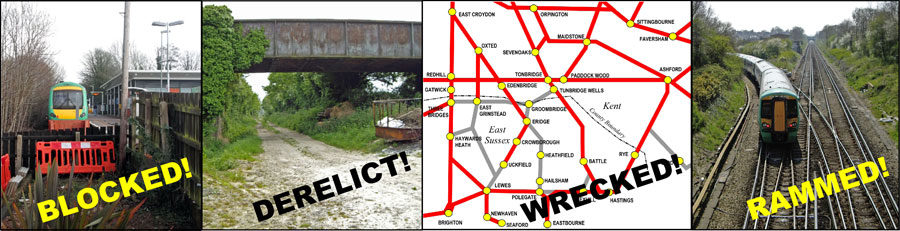
1: The former main line breached at Uckfield – 7 miles short of the coastal network!
2: It operated 50 trains per day before it was ‘eliminated’ – it now grows weeds rather than the regional economy.
3: The damage wreaked upon Sussex (indicated in grey are lines ‘eliminated’ from national rail network)
4: Trains operating per hour to the Sussex Coast through Haywards Heath =20
Trains operating per hour to the Sussex Coast through Uckfield =0
“Society as a whole would be worse off through reopening this line”– East Sussex County Council (9th February 2009).
The blight inflicted upon East Sussex and the wider South East endures, while individuals still in power prolong the legacy of those directly responsible for this incalculable catastrophe. In December, East Sussex County Council launched its ‘East Sussex Rail Strategy 2025-2050’. Headed by Rupert Clubb, ‘Director of Communities, Economy and Transport’, this 85-page document declares it ‘looks to connect people to places, providing rail connectivity for all’. ESCC claims it ‘recognises that the rail network plays an important part in the lives of our residents, businesses and visitors’ – something the Wealden Line Campaign has spent forty gruelling years promoting – despite this council’s stiff opposition.
ESCC says the railway ‘will encourage and enable more people to access key education, employment, services and facilities in the county’ before adding ‘Any worsening or reduction of services and/or infrastructure will be met with opposition’ [our emphasis]. Does that latter point include ESCC’s perfectly-deliberate undermining of the long-standing Trackbed Protection Policy for the strategic Uckfield–Lewes section so that a ‘surfaced wheeling and walking path’ can replace it....?
Unbelievably they say ‘Our ambition for rail in East Sussex is to ensure “transport connectivity for all” – this from an authority which acted so ruthlessly in being directly responsible for destroying the most-comprehensive rail network bestowed upon this once-fortunate southern county. Their shameful culpability in engineering this woeful legacy has impoverished its people; stunted economic prospects; harmed the environment and devalued the region. No wonder ESCC once had cause to lament the county’s GDP equated that of rustic Cumbria. And this tragedy is not confined to diminishing Sussex, but equally parts of Kent and Surrey. Since Rupert Clubb also heads Transport for the South East he should appreciate this.
Their new strategy bewails ‘East Sussex is poorly connected to the rest of the country, relative to other areas in the south east by both road and rail’ before telling us ‘Historically this line continued to Lewes, with the Uckfield–Lewes section of the line closed in the late 1960s’ – well, who fought so determinedly to bring that about...? They go on ‘A connection also existed on this route between Eridge and Tunbridge Wells. This ceased in 1985’. Indeed it did – and weren’t you roundly condemned at the time for not objecting to its closure!
As revealed in the book "Uckfield’s Railway ~ Triumph and Tragedy", National Archives files expose ESCC’s machinations in having not only the Lewes–Uckfield section ‘eliminated’ to use their exact word, but aspiring to have Crowborough, Eridge, Groombridge, etc, purged from the railway network. Although failing in that last objective, they fundamentally destroyed the double-track main line between London and Brighton via Uckfield which was on the very cusp of being electrified between 1962-4. The domino effect then took hold as a demoralised British Rail conceded defeat because with Lewes–Uckfield eliminated there followed the shelving of electrification, amputation of main line services through to Tonbridge, before culminating in the single-tracking of its pitiable remnants.
This 2025–2050 Rail Strategy is yet another whitewashing exercise from a roads-fixated County Council which has consistently used its dominance to prevent any restoration of this important main line. Instigated in 1986, the Wealden Line Campaign was rebuffed by Rupert Clubb’s predecessor, County Engineer, Brian Kermode ‘The option to reinstate the railway line between Lewes and Uckfield is no longer feasible and I have, therefore, to advise you that the County Council cannot assist you to achieve your aims’. That hostile stance was reinforced after ESCC Chief Planning Officer Malcolm Reece told us ‘Costs of reinstatement have escalated and various developments have made such reinstatement difficult – if not impossible.’ This necessitated Kermode and Reece’s ‘Joint Report’ to councillors ‘There are clearly very considerable physical and resource obstacles to the reopening of the line. In the absence of any proven evidence of availability of considerable new resources, it is judged to be unrealistic to maintain the option of reopening the line. It is, therefore, inappropriate to hold out any hope for the Wealden Line Campaign’s objectives being attained; indeed, it must be recognised that the objectives are in conflict with the County Council’s current stance.’
Concerned about fast-growing public/media support for the campaign, ESCC wheeled-out its time-honoured convenient excuse ‘In strategic terms the priority of the County Council is to achieve the improvement of both road and rail South Coast routes to link with the Channel Tunnel. The County Council does not want expenditure to be diverted from these priorities to the Lewes–Uckfield line.’ Even worse news for the struggling and criminally-blighted Uckfield line followed when this truly astonishing stance from ESCC’s Planning Department was made known ‘At present the line from Uckfield northwards to Oxted functions principally as a commuter service to Greater London. This is not a function of Crowborough or Uckfield that the County Council wishes to see expanded.’ How they lamented over not achieving their goal of getting the entire railway line connecting Sussex/Kent/Surrey ‘eliminated’ as this until-now highly-confidential memo from ESCC’s County Surveyor from 1966 discloses: ‘British Rail Proposed Closure: Hurst Green–Lewes–Eridge–Tunbridge Wells Central. The closure of this railway may increase the amount of commuter traffic from the Crowborough area to Tunbridge Wells and from the Uckfield district to Lewes or Haywards Heath, but this is not likely to be unduly significant compared with the overall traffic increase. However, the removal of this railway would enable a number of road improvements to be carried out at greatly reduced cost and facilitate an improved road alignment. This would be most significant as regards Uckfield Level Crossing and the bridges at Eridge, Crowborough and Groombridge, apart from several minor road crossings.’
Even the battle to safeguard the 7-mile ‘missing link’ south of Uckfield came under threat and it was thanks only to heroic efforts by worthy Town and Parish councillors that the Lewes–Uckfield Trackbed Protection Policy (TAE22) was secured in the County Structure Plan. When profit-hungry developers challenged this in March 1989, their counsel, Michael Uren QC, provided ample evidence to show ESCC had neither commitment nor interest in seeing the railway reopened. In his own words, he asserted their policy was “– nothing more than window dressing”.
During 1996-8 another ‘reinstatement study’ was successfully steered into the waste bin. The knives then came out in April 2000 when ESCC released its latest Local Transport Plan which surreptitiously weakened prospects for reopening Lewes–Uckfield after we discovered it now read ‘the route for which is largely protected (for low speed, single track operation only)’. The reasons behind this only became evident after ESCC’s hugely-controversial ‘Uckfield Gyratory Road Scheme’ was made public in 2006, engulfing the station site and hitherto protected trackbed. Clearing the way for this, the council’s Highways & Transportation minutes from 2005 revealed ‘The proposed reinstatement of a railway link between Lewes and Uckfield is considered to be unrealistic, should therefore not be a priority and should not receive resources.’
The popular Sussex Express newspaper championed local efforts by mounting its ‘Stop the Gyratory’ campaign. After being accused of attempting in Uckfield what they succeeded destroying in Lewes in 1969, ESCC’s ‘Director of Highways’ Robert Wilkins rebuked “To suggest that the County Council is not committed at either member or officer level to the reopening of the line is outrageous. For Brian Hart to suggest that we are pursuing a highway scheme that will kill off the railway is total nonsense.”
The now-infamous 2008 Lewes–Uckfield Reinstatement Study followed with ESCC seizing complete control. This travesty, which involved serious and detailed engineering input from Network Rail, soon degenerated. Gerrymandering gradually became evident; for example, NR’s laudably forward-looking statements being purged. The most-notable example struck out read: ‘If this scheme was taken forward then it could be seen as another building block in the development of the Lewes, Uckfield, Oxted and London corridor. Later developments could include shorter journey time, redoubling any single line sections, connecting into Tunbridge Wells, and electrification’. The Study’s true purpose became apparent after the ESCC Rail Board’s chairman, Cllr Rupert Simmons let slip to the press “This will resolve once-and-for-all whether this project is going to happen. We will be able to decide yes, we will give it our full support, or no, it is time to put a stop to the whole thing.”
Having accomplished their wholly-intended ‘negative case’ for reopening, ESCC’s new Highways Director Rupert Clubb, Cllr Rupert Simmons and NR’s Chris Curtis, then arranged a secret meeting at Westminster with the All Party Parliamentary Rail Group in February 2009. However, tipped-off by Lewes MP Norman Baker, the Wealden Line Campaign’s five committee members attended whereupon the pro-rail APPRG was told – as recorded that grim evening –“Society as a whole would be worse off through reopening this line.”
Having expunged reopening ‘once-and-for-all’, ESCC resurrected their Uckfield Gyratory Road Scheme soon afterwards. Fortuitously, the gallant Lord Tony Berkeley acted in due course, rescuing the railway’s prospects by his intervention, thus enabling Uckfield’s station site to pass into Network Rail’s safe ownership.
Another ESCC Rail Strategy came forth in 2013. On Lewes–Uckfield, a joint report produced by Rupert Clubb and Mike Fleming (Wealden District) and Lindsay Frost (Lewes District) satisfyingly pronounced there was ‘no business case despite being feasible on a technical basis’. They asserted: ‘The main reason for the poor business case is the low level of demand’ citing social changes in travel, namely widespread car ownership. However, it was only after George Osborne, Chancellor of the Exchequer, had instigated his ‘London & South Coast Rail Study’ in 2015, that it was discovered out-dated passenger figures from 1965 had scurrilously been used in ESCC’s 2008 Study to ‘prove’ a negative business case. Nevertheless, ESCC’s Director of Communities, Economy and Transport Rupert Clubb maintained his position, telling the County Council in August 2016 that reopening Lewes–Uckfield “did not offer value for money”.The cruel irony is that on that very date, Network Rail’s outstanding contribution in 2008 (purely its engineering aspects) reveals their scheduled ‘Project Handover’ for reopening Lewes–Uckfield would have been......August 2016.Thus the doleful tally of wasted years mounts up as the regional economy stagnates.
They cannot stop the Uckfield Line triumphing – all they can determine is how long they might continue prolonging the misery around its absence.....