

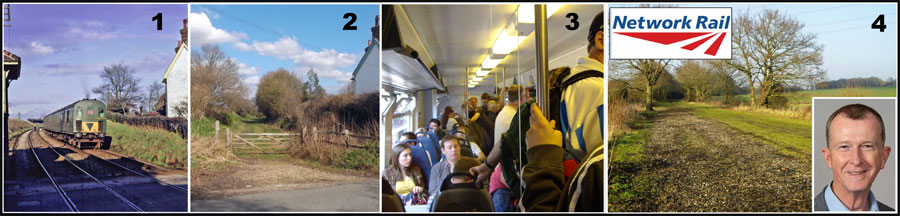
1: Brighton to London via Uckfield – to be fully-electrified by British Rail by June 1964. [photo courtesy John Wenham]
2: The scene today – the mainline deliberately ‘eliminated’ by East Sussex County Council.
3: Stuffed! (as usual) on the adjacent Brighton mainline.
4: Network Rail wants to deliver reinstating Uckfield – Lewes and says the trackbed shown here at Owlsbury must remain fully-safeguarded. Inset – Lewes District Planning Officer Cllr O’Connor who expects people from Oxted, Edenbridge, Tunbridge Wells, Crowborough etc, will catch the train to Uckfield then cycle/wheel/walk to Lewes to resume their train journey to Brighton, Eastbourne etc, and turn his “wonderful dream into an even better reality”.
The most significant step forward in almost twenty years has been made with Network Rail’s intervention by forcefully tabling its interest and thereby ensuring the future resilience of the overloaded Sussex/Kent/Surrey railway network.
This hugely-welcome development comes in response to Local Authority plans currently out for consultation by Wealden District Council (WDC). An outline application for a massive housing development comprising 1,700 new homes just west of Uckfield at Owlsbury Farm has caused substantial concern and opposition. Aside from a range of objections relating to the town’s very limited infrastructure and not least the harmful impact on surrounding verdant countryside, it presents a serious threat to the reinstatement of the strategically-important, former main line connecting Uckfield and Lewes.
To set it in context, Sussex’s infamous 7-mile ‘Missing Link’ in Southern’s regional network continues to be a running sore - ever since it was deliberately ‘eliminated’ in 1969 by East Sussex County Council (ESCC). Concerted efforts to safeguard the trackbed for reopening have continued ever since, despite hostility from both ESCC and WDC which have periodically attempted to completely remove, or at least seriously weaken, such needful protection. Just one of many challenges came in 2000 when it was discovered ESCC had surreptitiously changed hitherto safeguarding to ‘low speed, single-track operation only’.
Reinstating the line was heavily-favoured by former Labour Rail Minister Tom Harris in 2007 who told the Wealden Line Campaign:“It’s a good project – I want this to succeed. I think you have a really good case. I would really like this to go ahead”. Even at that time he was well-aware of the severe problems affecting the adjacent Brighton Line, with Network Rail and train operators struggling with a lack of sufficient capacity between London and the Sussex Coast. This coincided with Network Rail’s engineering departments thoroughly investigating and producing the most superb track/signalling/infrastructure report into how it could be easily reinstated. It said:‘There are no physical obstructions which would preclude the rebuilding of the railway between Lewes and Uckfield’ – and that still holds true. Intensely calculated in exact terms of costs and even its stage-by-stage delivery culminating in ‘Project Handover’ by August 2016, it was a stunning masterpiece, made possible as Network Rail’s managers confirmed:“The route remains largely unbreached” – thanks primarily to local efforts to keep it that way.
As we now know, the ineffable tragedy of the 2008 Study was allowing ESCC to seize full control in not only appointing its chosen consultants, but also wilfully determining its infamous ‘negative BCR’ (Benefit-Cost Ratio). Failing to achieve its ‘once-and-for-all’ no-case outcome, ESCC was only thwarted in building its 2009 ‘Uckfield Gyratory Road Scheme’ on Uckfield station, thanks to the laudable efforts of Labour Lord Tony Berkeley who saw the land successfully transferred into Network Rail ownership.
The full extent of deceit and manipulation in the 2008 Study’s Business Case only came to light in 2015-6 after Chancellor George Osborne instigated his ‘London & South Coast Study’ into reinstating Lewes – Uckfield and the wider BML2 Project. His consultants quite unwittingly relied on the passenger figures used in producing ESCC’s 2008 so-called Business Case. Thus the deceptionwas exposed because these train loadings originated from 1965 – when Uckfield’s population was 4,300 (14,493 in 2011 census) and Crowborough’s was 9,500 (21,275 in 2011 census). Furthermore and for obvious reasons, no allowance was made for the phenomenal rise in rail-usage some forty years on. Worst of all though, ESCC’s study intentionally paid no account whatsoever to through regional traffic; instead, restricting it to passenger traffic solely between Uckfield and Lewes.
This unmitigated travesty was pivotal in launching BML2 with its regional perspective beyond merely reopening a Sussex link that should never have been lost in the first place. With the Brighton mainline – and not forgetting the Tonbridge mainline – both facing severe capacity crises, the answer rested in rebuilding/upgrading/electrifying the Wealden mainline. BML2’s London Phase (aka ‘Thameslink 2’) came about due to the Department for Transport’s stock excuses of ‘insufficient capacity at London termini’, as well as its favourite, the ‘East Croydon bottleneck’. Then we had their ‘trains would nowadays face the wrong way entering Lewes from Uckfield’ – which is why BML2’s Ashcombe tunnel through the South Downs directly into Brighton attracted so much political interest and private investor involvement.
The DfT couldn’t grasp that BML2 wasn’t confined to the Uckfield line’s interests, but would give, for example, Brighton, Gatwick, Croydon, etc, direct access to Canary Wharf/Docklands/Stratford and even Stansted. Nor could they appreciate BML2’s Kent Phase which would reintroduce mainline trains from spacious Tunbridge Wells West to London – thus relieving the overloaded Sevenoaks route – and for which they still have no solutions. Appeals to the DfT to intervene and protect the Kent Phase’s strategic Groombridge – Ashurst former mainline link fell on deaf ears. Here’s the pathetic and shameful response we received in 2019: ‘The Government believes that local authorities and Local Enterprise Partnerships are best-placed to decide on transport issues that affect their local area.’ So what’s the use in having the DfT?
Meanwhile, we are STILL fighting to protect the Lewes – Uckfield trackbed. Lewes District Council remains intent on installing a nine-mile surfaced ‘wheeling’ path between the two towns using the mainline’s formation. Head of Planning & Infrastructure, Labour Councillor Laurence O’Connor said last month: ‘It will create a safe and sustainable travel route for residents and visitors for a greener, healthier way to move around.’ He goes on to hope LDC will get the backing from WDC (comprising Green/Lib Dem/Labour) and the South Downs National Park “– to turn this wonderful dream into an even better reality”.
Gravely concerned by this alarming prospect, on 16th March Uckfield Town Council, which knows full-well the unrelenting pressure from wide-scale house-building blanketing the region, voted unanimously to support Cllr Bennett’s submission which read: ‘Uckfield Town Council welcomes and strongly supports our County Council’s 2025 Rail Plan in recognising the pivotal role of rail and the development of the town’s connections to Lewes and Tunbridge Wells for modern railway use. We therefore urge and indeed expect ESCC to immediately reinstate the full trackbed protection* which existed in the Council’s Structure Plans.’
[* N.B. ‘trackbed’ means the full (fence-to-fence boundary) – that is the former double-track width of the erstwhile mainline and not protection for only a single-line reinstatement.]
Mindful of Transport Secretary Heidi Alexander’s recent approval of Gatwick’s Second Runway and its resulting and scarcely-appreciated adverse impact on the Brighton mainline, we applied for a Safeguarding Direction (which costs nothing) to properly protect the trackbed. We were therefore extremely grateful to Labour Lord Bassam of Brighton – a keen and long-term supporter of BML2 – who knows more than anyone the pressure under which the Brighton Line struggles on a daily basis. He tabled the following question: ‘To ask His Majesty's Government what plans they have, if any, to issue a Safeguarding Direction to protect the full width of the original track bed of the former Lewes to Uckfield rail line to facilitate its future use; and whether they will give further consideration to re-examining the potential value of the former Lewes to Uckfield rail line.’ (HL15637 Tabled on: 17 March 2026)
Disappointingly, though true to form, the DfT responded through the Rail Minister, Lord Hendy of Richmond Hill who signed off this statement: ‘The case to build or restore railway services over this alignment should first be assessed and supported by the local transport authority, who should relate the proposal to growth, jobs and homes in the area. As part of that assessment, whether the previous route is available for reuse and to what extent should be assessed at a high level. The local transport authority can then take a view about the practicability of using the route. My Department would only safeguard the route if there was a reasonable long-term prospect of the scheme having a business case and being funded.’
Network Rail is more than aware of the difficulties it faces in operations, particularly in the busy and congested South East. Expansion of the system has been the subject of discussion for decades, with even WDC complaining that East Sussex is poorly served by rail. Those who follow this campaign and have read Uckfield’s Railway ~ Triumph and Tragedy will know the culprits responsible, both past and present, in County Hall. Quite recently, Network Rail commented on Wealden Council’s housing plans, urging consideration be given with developments being convenient to accessing the railway. It is, after all, only the railway which offers us salvation from the increasing traffic nightmare we face – not this ‘active travel’ nonsense.
It is therefore with profound thanks to the rail industry to be made aware of this important directive just received and which comes from Network Rail.
17 April 2026 – SUBJECT: WD/2025/0922/MEA – Land West of Uckfield – Owlsbury Farm, Horsted Green, Little Horsted, TN22 5TJ.
OFFICIAL
Network Rail objects to the planning application reference WD/2025/0922/MEA.
The development fails to sufficiently safeguard the Uckfield – Lewes railway line and is therefore in conflict with the adopted Core Strategy. The illustrative master plan identifies the railway line as disused and appears to provide a direct connection to this. Additionally, there are several features too close to the railway line including a children’s play area.
The application will stifle the future delivery of the Uckfield – Lewes railway link and impact on safeguarded land and conflicts with adopted policy.
Craig Hatton MA MRTPI
Senior Town Planner, Network Rail Property (Southern), 1 Puddle Dock, London EC4V 3DS
Everyone who has followed this campaign since 1986 and wants the region to thrive, see its inhabitants prosper and have access to decent, safe, modern transport, will join us in applauding Network Rail for taking this robust stance. Their 2008 Engineering Study remains valid and thoroughly practicable. It now needs proper political support, an honest business case, and the swift delivery it was so deceitfully denied eighteen years ago.