

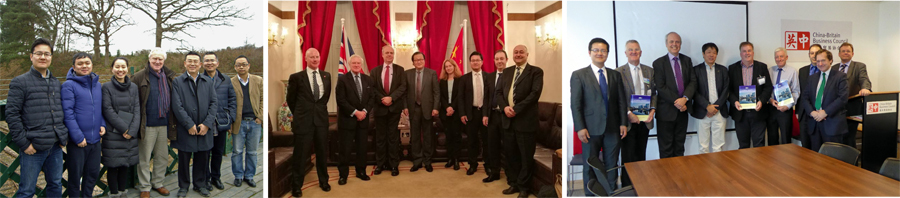
1) Representatives from the China Railway Engineering Corp inspect the former main line at Groombridge on the Kent/Sussex border.
2) BML2 representatives, its legal team and investors meet at London’s Chinese Embassy in 2016.
3) Discussing ‘BML2 – A Capital Project’ at the Mayfair headquarters of the China–Britain Business Council.
The visit to China by UK Chancellor Rachel Reeves poses a tantalising prospect – namely has she the foresight to succeed where her compatriots have failed....?
Only those with perception and intelligence seem capable of grasping the widespread benefits which the Brighton Main Line 2 (BML2) project would bestow upon London and a vast swathe of the congested and overcrowded rail network in the South East. Its three phases – London / Kent / Sussex – were specifically designed to solve the vexing problems of these regions, predicaments which continue to stifle growth, obstruct enterprise and hinder well-being.
Even now, the Department for Transport (DfT) still persists in blocking any progress on BML2. To begin with, its go-to excuse for not returning the south’s Uckfield branch to its former main line status (wilfully destroyed for a minor road scheme in Lewes in 1969) is that trains from London, Surrey, Kent, etc, can subsequently no longer run directly into the City of Brighton & Hove – as they used to do for over a century (1868–1969). While Network Rail bemoans ‘Sussex railways are the most congested in the UK’ a solution was – and still is – badly needed. Furthermore, since rail travel is predicted to double by 2035 we need to act fast. Here in the South East it’s not about high-speed – but achieving substantially far greater railway capacity and connectivity. With today’s degraded Uckfield branch running roughly parallel to the Brighton Line, reinstating its paltry seven miles towards the Sussex coast network is something blindingly obvious to most people.
BML2’s Sussex Phase involves a new 1½ mile (2.4km) tunnel through the South Downs whereupon Brighton and neighbouring coastal towns gain a new direct main line to London. But this is where the DfT rolls out another of its do-nothing excuses – namely the infamous East Croydon bottleneck. Before we look into that, we should mention Kent whose network suffers pretty much the same problems regarding overcrowding. In 2017 Network Rail declared the congested Tonbridge Main Line desperately needed five more train paths into London, concluding in clueless business-speak ‘there are no obvious or clear infrastructure solutions to meet the capacity conditional outputs’. Since Tunbridge Wells contributes the largest proportion of passenger demand, BML2’s Kent Phase, which reopens Tunbridge Wells’ other main line link to London via Oxted (also closed in 1969) it is similarly obvious what needs to be done.
Let’s be clear, BML2’s London Phase is patently the most-ambitious and expensive of all. That said, the transport gains, public benefits and wealth-creating opportunities are truly stupendous. Back in 2009 when BML2 was being investigated to see whether the concept was really viable prior to its launch, the proposal was to bring back into use the former double-track electrified railway between Sanderstead (South Croydon) and Elmers End which variously closed between 1983–97. Usefully avoiding the notorious and insuperable East Croydon bottlenecks, the scheme would enable thousands of rail travellers daily to access London on these direct services and who had no need to jam-up East Croydon. The Croydon Tramlink, which subsequently used sections of this line, could feasibly be shifted and indeed, even improved. Then, In 2011, Network Rail’s Sussex Route Study concluded: ‘a scheme that removed Fast Line services from the existing Brighton Main Line [BML] somewhere in the Croydon area would be the ultimate capacity generator’
Following talks with Lewisham Council and London Overground, a colleague from the latter described it as BML2’s‘moment of genius’ when we suggested that, rather than attempting to run trains into London termini – as per Network Rail’s proposal – we do something far more advantageous. This was when the London Phase – or ‘Thameslink 2’ – as it became known, really took off. A new rail tunnel beneath the River Thames to serve Canary Wharf and Docklands and on to Stratford International (HS1) would open up enormous commercial opportunities for the capital. The realisation of its scope and benefits snowballed with prominent political figures becoming interested and involved. Not only would this ‘Thameslink 2’ usefully join together Essex and Kent through East London, it would remove major congestion in Central London for all those working at Canary Wharf and Docklands who otherwise jammed up termini and the Underground/Overground lines. The next bonus came with the ability to directly connect Gatwick and Stansted Airports with a fast and seamless rail shuttle – coined ‘Stanwick’ at that time.
Meetings between the BML2 Project and the Canary Wharf Group followed in 2016, whilst serious private investors then became heavily involved and who immediately recognised its business potential. Meanwhile, interest grew among MPs and Government: 'The Transport Secretary [Chris Grayling] has met with promoters of the BML2 concept and encouraged them to continue to develop their proposals for it to be delivered and funded privately’ – Paul Maynard, Transport Minister.
Other prominent political figures joined in – Labour’s Lord Adonis, Chairman of the National Infrastructure Commission declared: ‘It is stark staring obvious that the second mainline to London is needed. BML2 – by reconnecting Brighton with London as one seamless journey – has the potential to do this. It is therefore a strong contender for serious investment because it would strengthen the existing overloaded network.’
Conservative Chancellor of the Exchequer, the Rt Hon George Osborne, visited Sussex in 2015, famously declaring it ‘– a part of the country so often ignored, or left behind under previous Governments’. In a statement he said ‘Effective transport links are vital for our economy to function properly. This means providing significant transport investment to places like the South Coast, where it is essential to have excellent connectivity between London and places like Lewes and Brighton. I want to take the opportunity to look at rail links in Sussex more generally, including the viability of a Brighton Main Line 2.’
Brighton’s City Leaders appreciated the huge win BML2 would deliver. Quite aside from so usefully connecting the Brighton Main Line via Gatwick to Canary Wharf and beyond, it would place Falmer (University of Sussex and AMEX stadium) on a direct line to London via Oxted – incidentally where Sir Keir Starmer grew up. Labour Lord Adonis was not wrong when he said ‘The loss of Brighton’s second main line via Uckfield and the direct services it provided was a massive error of the 1960s – it needs to be reversed.’
Long-term BML2 advocate, Lord Bassam of Brighton remains as keen as ever to see it happen. He summed it up perfectly when he said ‘We must have a long-term, permanent solution to reduce pressure on the BML and expand capacity between Sussex and London. I believe BML2 does just that. What we have before us is a very sensible and straightforward scheme. It makes economic sense to expand and capitalise on what assets you already have. BML2’s other strength is that it puts Falmer on a fast main line to London. The same goes for tourism, which is immeasurably important to Brighton and the South Coast. We want people to come here and enjoy the city, the seaside, the countryside and all that Sussex offers, which is why I’m such a strong supporter of this project. Quite simply, BML2 deserves to win on environmental, transport, tourism and economic efficiency grounds – it has everything going for it.’
The defining step forward came with the serious involvement of the China Railway Engineering Corporation. Numerous meetings between their representatives and UK investment companies occurred during 2016-17, whilst the BML2 Project Team was invited for talks with the China-Britain Business Council at their Mayfair headquarters in London. Understandably, the Chinese were largely interested in the London Phase given their significant involvement in developing Docklands. However, understanding the constraints under which the South East’s rail network laboured, notably the Brighton Main Line, they sought on-site visits to both East Sussex and Kent and were given a guided tour. Impressed by what they saw and the ease of engineering necessary to deliver the Sussex and Kent phases, the focus then moved to the London Phase.
The Corporation and the investors then looked towards a far more expensive option involving tunnelling for most of this phase. Significantly, they were convinced of its merits and looked upon it as a ‘showcase project’ – to be delivered on time – and at a fixed price. They wanted nothing to do with the DfT’s obsession over HS2 – clearly a very shrewd decision on their part. They were not seeking to operate the new railway once complete, or retain ownership once project handover was reached. As John Miu, of Chinese company APB London said regarding the Royal Albert Docks ‘We believe in the market – we’ve invested in London’ reinforcing his confidence in the British capital by adding that it ‘rises up every time, no matter what crisis flows into it’. With the Chinese not only believing, but intent on making Royal Docks ‘one of the most successful business districts in London’ it is not difficult to understand why so much interest was directed by them towards BML2 and Thameslink 2.
Despite this and all the effort and dedicated hard work which went into BML2 across many years, neither interest nor helpful participation from officials from the Department for Transport was ever forthcoming. This led to the frustrated investors eventually walking away, remarking in despair that all these civil servants appeared interested in was their positions and their index-linked pensions.....
BML2 can be delivered in its entirety or by individual stages – because each offers significant benefits. So can the South East look forward to any real change?