

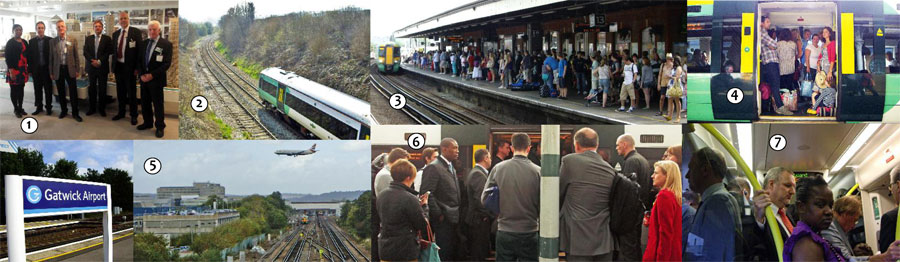
(1) BML2 Consultancy Ltd at Canary Wharf HQ a decade ago. (2) The South East’s broken main line.
(3 & 4) Totally stuffed! – the off-peak crush on the Brighton Line.
(5) London Gatwick in for a disappointment – and a very hard landing! (6 & 7) The Transport Policy going nowhere.
Sir Keir Starmer’s administration is ‘minded to approve’ a second runway for Gatwick Airport – the decision delayed until October. That’s because the Government says its ‘take-off’ is dependent on 54% arriving by public transport as the airport is expected to generate 30 million more passengers!
But Gatwick is condemned to failure and will lose out for two currently insuperable reasons. Firstly, it is trapped on the Brighton Mainline which imposes a straightjacket on any expansion of passengers arriving by train. The Sussex route is, as Network Rail says ‘a major barrier to growth’ – already at over-capacity, caused by the amount of services which it has to accommodate from multiple coastal towns and stations in between where commuters and off-peak passengers jostle for space. It’s a decades-long problem which the DfT mandarins and successive Governments have disgracefully allowed to fester.
Twenty years ago Network Rail fully appreciated its growing dilemma with too many passengers using the line between London and Brighton. Two solutions were proposed – one was to have longer (16-car) trains, but this would mean extensive track alterations and platform lengthening. Their other proposal seriously suggested introducing continental-style double-deck trains; however, the route’s Victorian tunnels presented problems. Network Rail proposed building seven new parallel tunnels to Brighton, with one track being slued to the middle of the old tunnels for these higher-gauge trains. A drawback was the extended ‘dwell time’ at stations while people boarded and whereas more passengers could be carried, neither option would enable any more services to operate!
This is why BML2 was developed in 2010. With just one new tunnel through the South Downs, a wholly viable, new and direct main line from London to the Sussex Coast – to Brighton, Lewes, Eastbourne, Newhaven, etc, would be created. Thus, the age-old crisis could be solved by restoring the Uckfield (Wealden) line to its former main line status and re-routing some services to give Network Rail additional capacity for more trains on the Brighton line.
As always, the DfT’s cited its favourite lackadaisical ‘do-nothing’ excuse – the East Croydon bottleneck. Consequently, BML2’s London Phase was then developed, snappily-called ‘Thameslink 2’ to demonstrate how a fast line avoiding this bottleneck should not go to a terminus (as Network Rail had previously conjectured) – BUT straight across the Thames to serve the capital’s growth areas at Canary Wharf, Docklands, Stratford – and furthermore continuing to London Stansted. This is when BML2 really took off (pardon the pun). Connecting the Brighton mainline directly to Canary Wharf etc, was a concept the DfT didn’t understand – and still doesn’t – as demonstrated by DfT representative Shane Snow recently saying that ‘Crossrail 2’ has priority and Sussex folk must walk, cycle or ‘wheel’ their way around on the trackbed.
So the first challenge for Gatwick – and all of us – is increasing route capacity (that is having more trains) between London and the Sussex Coast. The second challenge is perfectly feasible to achieve – provided the Government has the drive for change – and the ability to govern over the wet blankets in the DfT. But you needn’t take our word for it – here’s what the experts said ten years ago in the Howard Davies Report on Heathrow-versus-Gatwick airport expansion.
‘With only one railway line and one strategic road corridor to the airport it [Gatwick] will suffer more in the event of major incidents, causing significant disruption due to the limited alternative options. Heathrow on the other hand with four rail and light rail routes into London would be better able to respond to major disruptive events such as the complete loss of a transport artery. Heathrow’s direct connection to Crossrail will link it to the capital’s main business districts– a second runway at Gatwick could not match the broader strategic impact of new capacity at Heathrow. This is due to its weaker links to the capital’s major growth areas.’
Heathrow won hands down because the report said it is ‘–open to a wide catchment area, including to the growing populations in the east of the city, which would have convenient access to jobs at and around the airport via Crossrail. This link will, for example, bring both Stratford and the Royal Docks within 45 minutes of the airport.’
Specifically dealing with Gatwick, Davies then said: ‘The strong links into central London and further afield provided by the Brighton Main Line and the Thameslink network would provide convenient access to the airport from other Opportunity Areas such as Kings Cross and London Bridge, and the direct link to Crossrail at Farringdon would connect the airport to the London’s key east-west growth axis. Gatwick would not, however, have a direct rail link to anywhere further east.’[our emphasis]
That killer blow, which STILL applies, explained: ‘– a second runway at Gatwick would not match the broader strategic impact of new capacity at Heathrow. This is due both to the lower overall scale of its impacts, the limited scale of the regeneration opportunities in the vicinity, with the exception of Croydon, and its weaker links to the capital’s major growth areas, with no direct rail connection in particular to any location to the east of Farringdon or London Bridge.’
In early 2015 the BML2 Consultancy gave a private presentation at the House of Lords to Labour’s Lord Andrew Adonis and Lord Steve Bassam, along with Canary Wharf’s Strategic Advisor Howard Dawber – who is now, in 2025, London’s Deputy Mayor for Business. We showed how Gatwick could wipe the floor with its competitors by having a non-stop mainline to the Wharf. A possible ‘Croydon Gateway’ station or a tunnel through here, could allow Gatwick Express to speed through unhindered. The creation of ‘Stanwick’ (a dreadful appellation!) would allow express services to operate between Gatwick and Stansted as one seamless rail operation – thus removing the constraints of turning trains around at London termini with all their congestion.
Adonis thought BML2/Thameslink 2 might have to wait until after Crossrail 2 had been built – whereupon Howard Dawber immediately interjected – “Crossrail 2 is no use to Canary Wharf” – and insisted they wanted Thameslink 2. Mr Dawber then said: “If Davies favours Gatwick – then we’ll waste no time in getting Thameslink 2 on the drawing board this summer.”
At that meeting and in referring to BML2, Howard Dawber said Canary Wharf Group was really only interested only in its London Phase and turning to us, said: “We don’t mean to be disrespectful, but we don’t care what happens south beyond Gatwick”. The trouble is, unless Sussex’s intrinsic and long-running problems are sorted with BML2 – then Gatwick is going absolutely nowhere. As the Conservative Leader of Brighton & Hove City Council, Geoffrey Theobald said at the time: “Unless the nettle is grasped over BML2, Brighton & Hove and the whole of Sussex is in danger of getting stuck in a siding.”
In private correspondence to the CEO of Gatwick, Stewart Wingate, BML2 Group wrote: ‘We hear private sector funding towards Thameslink 2 is available, but under wraps, as they don’t see why they should pay for it all. We are also informed Chancellor Osborne is willing to tackle the Treasury and may well be persuaded to contribute towards what could be a useful and quick political win. Transport plays such a pivotal role towards business growth and regeneration that Canary Wharf Group will have access to business influence and investment streams and, quite honestly, Thameslink 2 cannot be anything but a massive success.’