

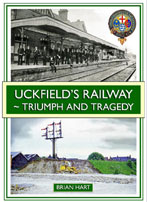
 UCKFIELD’S RAILWAY ~ TRIUMPH AND TRAGEDY
At the dawn of the great railway era, Sussex was transformed when the London to Brighton line opened in 1841. The railways positively boosted the towns and counties they served, bringing trade and prosperity. Investors were keen to subscribe to this ‘Marvel of its Age’ as the network of lines was so diligently crafted.
Uckfield was reached in 1858 when the railway coming up from Lewes opened to great rejoicing. Apart from farmers and tradesmen who benefited from this marvellous development, local people were fascinated by this new means of travel which enabled them to journey in speed and comfort compared with the slow, expensive and unreliable alternative offered by horse-drawn coaches. Consequently, excursions brought people and trade into hitherto inaccessible parts of Sussex.
Sussex’s network was largely financed by private investment in the magnificent London, Brighton & South Coast Railway. The LB&SCR was keen to establish its territory from its competitors; namely the South Eastern Railway and the London, Chatham & Dover Railway companies, who were also fighting each other in their aim to spread rapidly throughout Kent. However, the financial crisis of 1866 brought many projects to a standstill, notoriously the LB&SCR’s Ouse Valley Line. Today, its remains at Uckfield continue to fascinate people. The author, similarly intrigued, was therefore determined to unearth its story and provide the most comprehensive account ever of this famously doomed railway.
Whereas all work on the Ouse Valley Railway ceased in 1867 – never to restart – some projected lines to Uckfield, such as the railway from Hartfield across Ashdown Forest, as well as the ‘East Sussex Junction Railway’ and the ‘Sussex Central Railway’ went no further than the drawing board.
Fortunately, the LB&SCR went on to extend its Brighton and Uckfield line to Tunbridge Wells, then up to Oxted, so that by 1890 it had created a superlative network linking Sussex, Surrey and Kent.
The intriguing story of how this all came about during the Victorian era has been thoroughly researched and is explained by the author, intertwined with a rich mixture of everyday occurrences which considerably bring his narrative to life.
Many improvements followed in the late-Victorian and Edwardian era whilst numerous events involving the railway are featured. This was both an exciting and challenging time and one of great advancement until the outbreak of the First World War changed life in many ways.
Absorbed into the Southern Railway in 1923, popularly known as ‘The Sunshine Railway’, travel by train grew rapidly – for commuting, school journeys, day-trips, weekend excursions – and happy holiday-times.
Alongside chronicling the life and times of the railway, its staff, the mishaps and the day-to-day events, the book features over 400 illustrations, including many hitherto unpublished photographs which bring a wholly-new perspective to the history of the wonderful Uckfield Line throughout these years of steam and are superbly presented here.
As the age of steam on the Southern Region began drawing to a close, further electrification was planned. In 1957 BR announced work on electrifying all the so-called ‘Oxted Lines’ (South Croydon to Lewes via Uckfield and also to Tunbridge Wells West) would start in 1962. Electric trains were promised to commence operating by 1964. However, these lines were already so busy and alongside new housing estates and fast-developing commuter traffic, BR was forced into introducing its ‘Oxted Lines Interim Dieselisation Plan’ as an urgent stopgap solution.
So what happened....?
Why wasn’t the railway electrified from South Croydon to Tunbridge Wells and to Lewes via Uckfield – exactly as planned by 1964?
Why was the Uckfield Line lumbered instead with increasingly ageing diesel trains – and subsequently left to rot?
Why did this important main line connecting Sussex / Kent / Surrey end up being destroyed when it was about to be modernised?
Why did BR then reduce sections of the Uckfield line to single track, reducing capacity and leaving the Brighton Line to become even more congested and over-crowded?
Why have no lines ever been reopened in the jam-packed South East?
Why do trains today stop at Uckfield and can no longer run directly to Brighton and all the popular Sussex Coastal towns?
Who was responsible for this happening?
Why have persistent calls for over 50 years to reinstate the Uckfield Line’s connections never been successful?
To answer all these questions and see the full supporting evidence, you need to buy your own copy of this amazing and well researched book that is now available direct from Wild Swan Books, some Heritage Railway shops or your usual local or on-line bookshop under ISBN 978 1 912038 97 8
For those people living in the local (Uckfield) area, the book will be available to purchase from BRIDGE COTTAGE when the heritage building admin office is open.
Railway Preservation Societies and the General Public will be amazed at the shenanigans that are revealed. It is truly a shocking story which must be told and kept in the public domain.